Why New Jersey Is Building More Homes Near Train Stations

Why New Jersey Is Building More Homes Near Train Stations—and What It Could Mean for Property Values
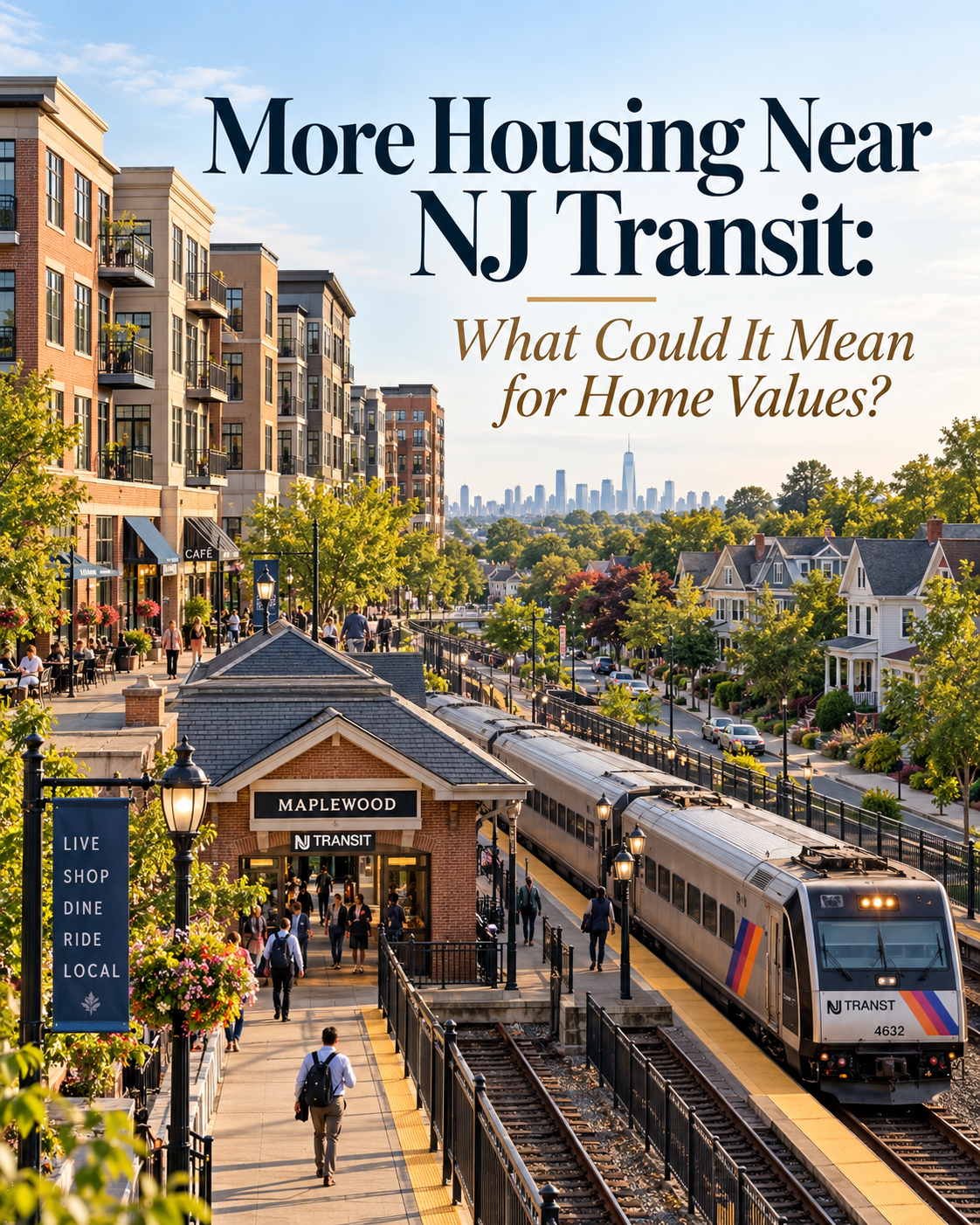
New Jersey is putting more attention on housing near train stations, and homeowners may be wondering what that could mean for their property values.
The short answer is that the state sees transit-oriented housing as a way to add much-needed homes in places that already have transportation, roads, businesses, and public infrastructure. NJ TRANSIT is also looking at underused land around stations as a source of housing and non-fare revenue.
For nearby homeowners, the effect on property values is less predictable. Research from Rutgers has found an association between rail access, transit-oriented development, and higher residential values in some New Jersey locations, but that research does not show that every transit project automatically raises surrounding home prices.
Why Is New Jersey Building More Housing Near Train Stations?
New Jersey needs considerably more housing, and the state is looking at areas near transit as one place to add it.
Governor Mikie Sherrill's September 2026 housing strategy estimates that New Jersey needs roughly 350,000 additional homes to keep pace with housing needs and economic growth. The plan calls for more construction near transit, employment centers, established downtowns, and other areas that already have infrastructure.
The state is also targeting underused public property, vacant offices, aging commercial sites, and other previously developed land.
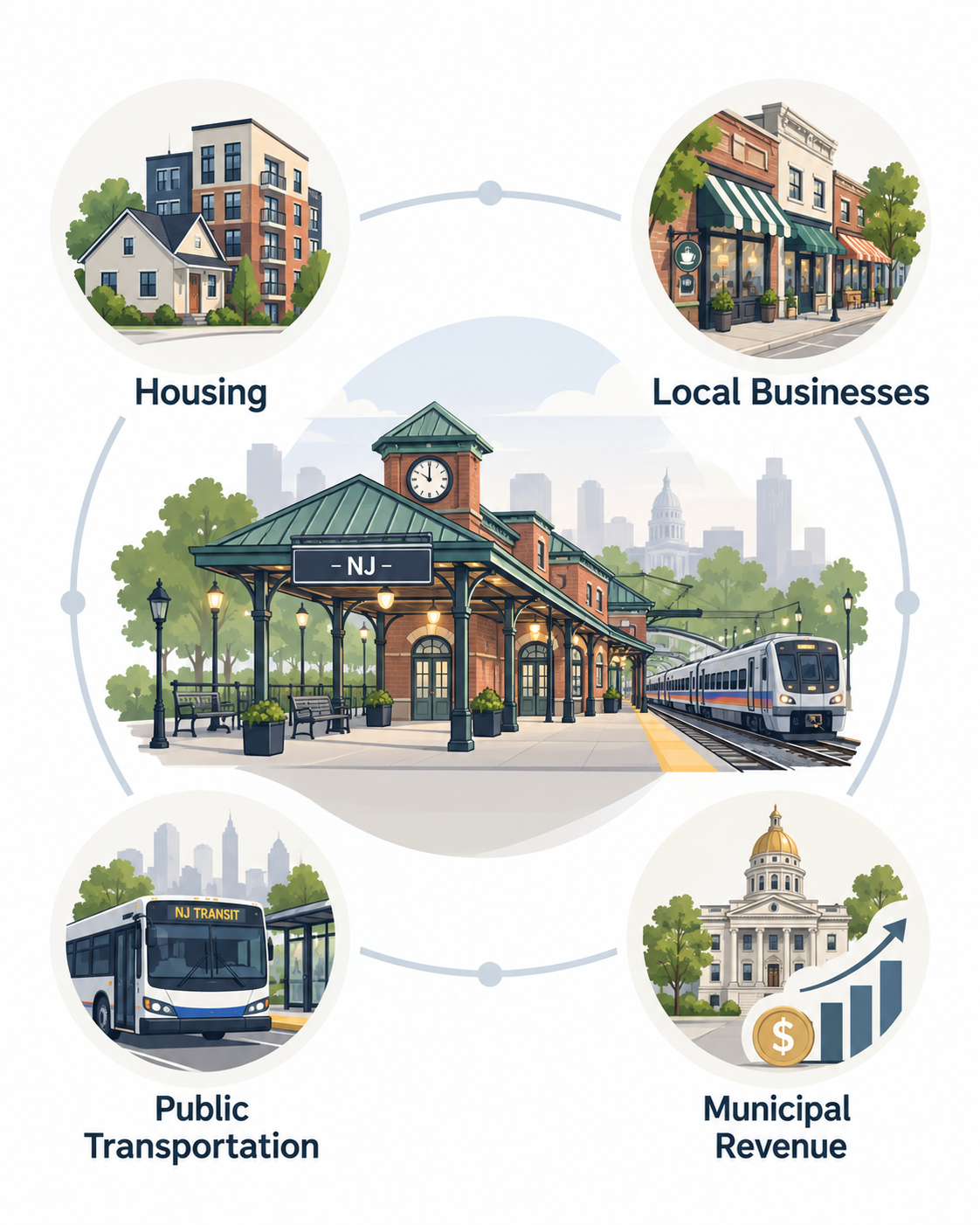
This approach can accomplish several goals at the same time:
Add housing without relying only on undeveloped land
Put more homes close to public transportation
Reuse parking lots and other underused parcels
Support existing downtown businesses
Create additional municipal tax revenue
Generate non-fare income for NJ TRANSIT
Improve pedestrian and bicycle connections around stations
New Jersey's 2026 housing strategy specifically identifies development near transit as a major part of its plan to increase housing production.
What Is Transit-Oriented Development?
Transit-oriented development, often called TOD, generally refers to housing and commercial development concentrated around public transportation.
In New Jersey, that can mean apartments, condos, retail space, public areas, pedestrian improvements, bicycle facilities, commuter parking, and other uses located near a rail or light-rail station.
NJ TRANSIT currently lists active, pre-development, and prospective projects at locations across the state, including Bayonne, Hoboken, Metropark, Somerville, Linden, Red Bank, South Orange, Princeton Junction, Edison, Long Branch, and other station areas.
The idea is not simply to place an apartment building beside railroad tracks. Many projects are intended to create a connected station district where residents can reach transportation and nearby services with fewer car trips.
Why Is NJ TRANSIT Interested in Housing Development?
Housing near stations is also part of NJ TRANSIT's real estate strategy.
In October 2025, NJ TRANSIT released its LAND Plan, Leveraging Assets for Non-Farebox Dollars, which examined development possibilities within the agency's roughly 8,000-acre real estate portfolio.
The plan estimated that development and other real estate opportunities could potentially support:
14,000 to 20,000 new housing units
30,000 to 50,000 jobs
Up to $1.9 billion in additional NJ TRANSIT revenue over 30 years
Up to $14 billion in statewide economic impact
Up to $1.6 billion in municipal revenue
These are estimates and opportunities identified by NJ TRANSIT, not guarantees that every proposed unit or project will be built.
For the agency, station-area development can turn land such as surface parking lots into a source of recurring revenue while also putting more potential riders near public transportation.
Where Is This Already Happening?
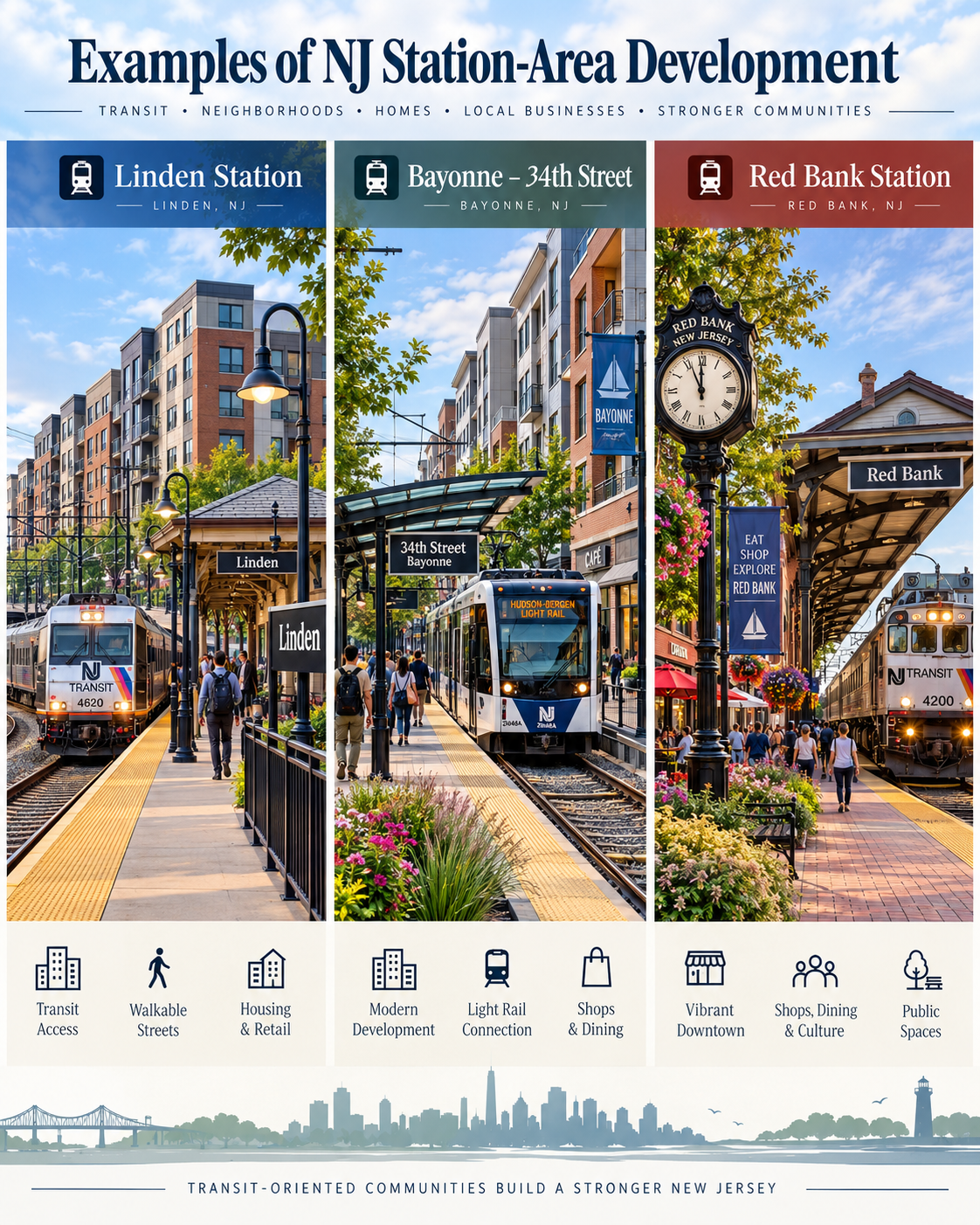
Several projects show what New Jersey's transit-oriented housing strategy can look like in practice.
Linden
In July 2026, the New Jersey Economic Development Authority sought proposals to redevelop a commuter parking lot next to the Linden NJ TRANSIT station.
The property at 101 West Elizabeth Avenue sits between existing mixed-use developments. State requirements call for transit-oriented housing along with resident and commuter parking, energy-conscious design, and improved pedestrian connections.
Bayonne
NJ TRANSIT is also pursuing development of a 4.3-acre parcel next to the 34th Street Hudson-Bergen Light Rail station.
The proposal calls for apartments, retail or commercial space, public areas, commuter parking, bus connections, bicycle infrastructure, and station improvements. At least 20% of the proposed housing is expected to meet affordable-housing requirements.
Red Bank
At Red Bank Station, NJ TRANSIT identifies The Centre at Red Bank as a planned multi-phase project with residential and retail space, structured parking, a public square, station-access improvements, and additional green space. Twenty percent of the apartments are planned as affordable housing.
These projects illustrate the broader idea: adding homes near existing transportation while making greater use of land already associated with public infrastructure.
Could Building Near Train Stations Raise Nearby Property Values?
It could in some locations, but homeowners should be careful with broad predictions.
Rutgers University's Alan M. Voorhees Transportation Center studied residential property values in New Jersey communities participating in the state's Transit Village program.
Researchers found some limited positive evidence of an association between Transit Village designation and residential property appreciation, but they could not establish that the designation itself caused the increase.
A separate Rutgers study looking at eight transit stations with TOD found that access to train stations was reflected in higher residential valuations and that mixed-use development may also contribute value. The study found a particularly strong connection between property values and stations offering direct access to New York City.
That distinction matters.
A new apartment building near a station does not automatically make every nearby house worth more.
Why Can Transit Access Be Valuable to Homebuyers?
Transportation access can be one factor buyers consider alongside price, property condition, taxes, size, parking, downtown access, and other features.
For buyers who commute by train, being closer to a station can reduce the amount of driving required before and after the rail portion of a trip.
Station-area projects may also add:
Restaurants and retail
Sidewalk improvements
Public areas
Bicycle facilities
New streetscape work
Housing choices
Easier access to transportation
Rutgers research suggests that station access itself can carry value, especially where rail service provides strong connections to major employment destinations.
That does not mean every buyer wants to live immediately next to a station. Preferences differ, and factors such as traffic, noise, parking, construction, and building density can affect how individual properties are perceived.
Could New Housing Put Downward Pressure on Existing Home Prices?
More housing means more supply, but the relationship between supply and the value of an individual home is more complicated than simply “more homes equals lower prices.”
New station-area apartments may not compete directly with a detached single-family home several blocks away.
A condominium development, however, could create additional competition for nearby condo sellers. New townhomes might have a greater effect on existing townhomes in a similar price range.
Sellers should ask:
What type of housing is being built?
How many units are proposed?
Will they be rentals or for-sale homes?
What price points will they target?
How close is the project to my property?
What amenities are being added?
How much competing inventory already exists locally?
These questions are much more useful than assuming that new construction will automatically help or hurt property values.
Could Redevelopment Around a Station Help an Existing Downtown?
That is one of the state's stated goals.
Putting more housing near existing downtowns can place additional residents closer to shops, restaurants, services, and public transportation.
The Linden project, for example, sits next to existing mixed-use development, while Red Bank's proposed station project includes commercial space and a new public square.
New Jersey's broader housing strategy also calls for housing production near existing town centers while preserving open space elsewhere.
For homeowners, changes to a downtown or station district can affect how buyers perceive convenience and transportation access, although the resulting impact on an individual property's value will still depend on local conditions.
**Image suggestion:** An attractive New Jersey downtown streetscape showing storefronts, sidewalks, a train station entrance, and mixed-use buildings. Avoid imagery suggesting any particular demographic.
What Could This Mean for Homeowners Near NJ TRANSIT Stations?
Homeowners should think about both the opportunity and the potential changes.
A major station-area project could influence:
Buyer interest in transportation access
Nearby retail and commercial activity
Local traffic patterns
Parking availability
Rental and condominium supply
New-construction competition
Property-tax revenue for the municipality
Streetscape and pedestrian conditions
Some of these factors may support buyer interest. Others could affect different properties in different ways.
The effect may also take years to appear because major development projects have to go through planning, financing, approvals, construction, and leasing or sales before the surrounding market fully responds.
What Should Sellers Do If New Housing Is Planned Near Their Home?
Start by learning exactly what is proposed.
A headline announcing “500 new homes near the station” does not tell you enough to make a selling decision.
Look at the actual site plan, property type, expected construction schedule, parking plan, commercial component, and distance from your home.
Then compare that with current market conditions.
For a seller, useful questions include:
1. How much competing inventory exists today?
2. What have comparable homes recently sold for?
3. Are buyers currently paying more for station access?
4. Will the proposed development compete directly with my property type?
5. Could new commercial or public improvements affect buyer interest?
6. Will construction timing overlap with my planned sale?
A local market analysis can provide far more useful information than a statewide average.
What Does This Mean for Sellers in Union, Morris, Middlesex, Somerset, and Essex Counties?
Transit plays an important part in many communities across Christine Cederquist's service area, but each market behaves differently.
A property near a station in Union County should not automatically be valued the same way as one near rail service in Morris, Middlesex, Somerset, or Essex County.
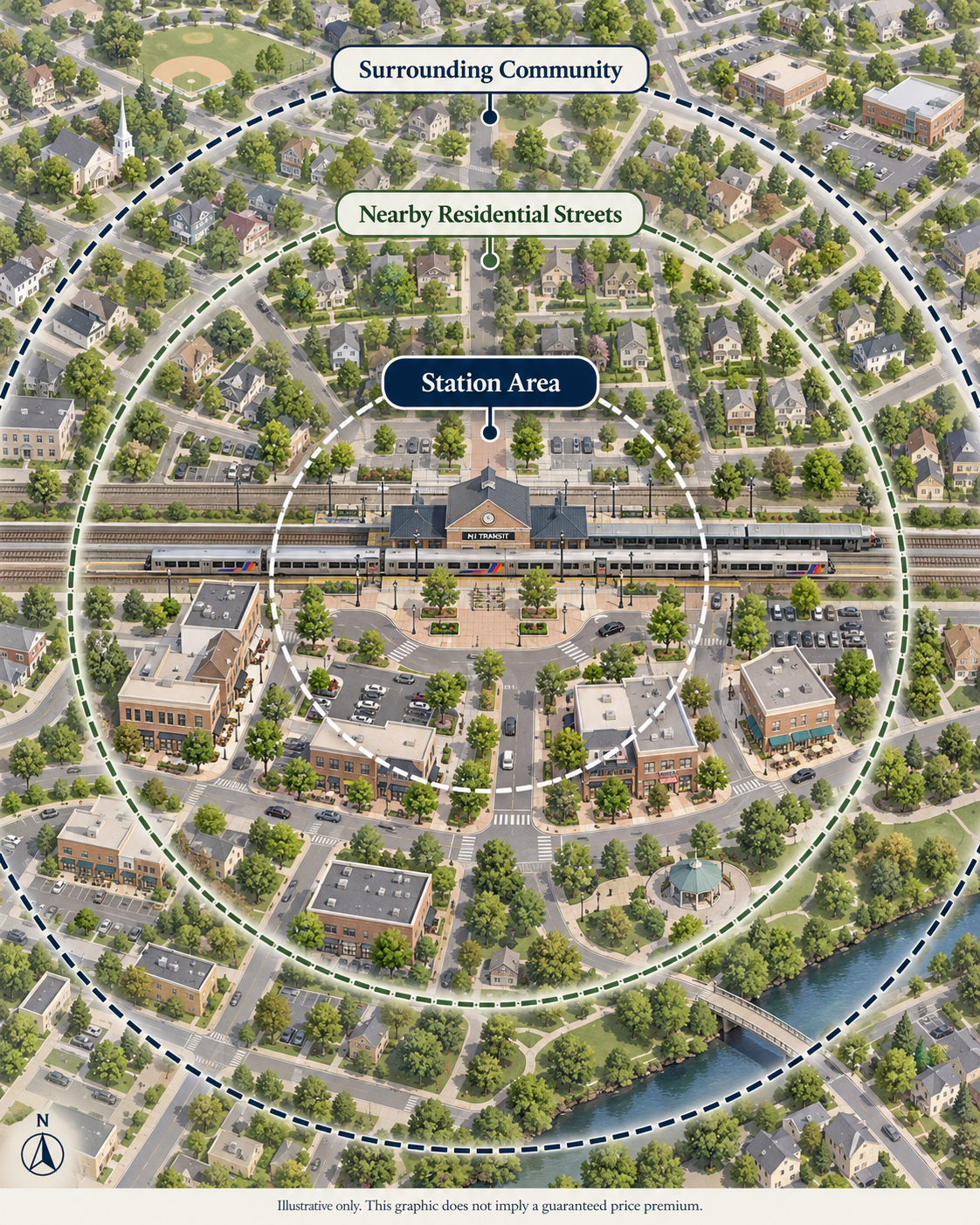
Local factors matter, including:
Current inventory
Recent comparable sales
Property type
Renovation level
Lot size
Taxes
Parking
Frequency and type of train service
Distance from the station
Nearby commercial development
Planned construction
Even within the same municipality, a house two blocks from a redevelopment site may face different considerations from one farther away.
Is Transit-Oriented Housing Likely to Continue in New Jersey?
Current state policy strongly suggests that station-area development will remain an important housing strategy.
New Jersey's September 2026 housing plan calls for roughly 40,000 potential homes on state-owned land and specifically identifies development near transit as part of the effort to address the state's housing shortage.
NJ TRANSIT also continues to list numerous active, pre-development, and prospective TOD sites across its system.
That does not mean every proposed project will be approved or constructed exactly as originally presented.
It does mean buyers, sellers, and property owners in rail communities should pay closer attention to development plans around their local stations.
Thinking About Selling a Home Near a New Jersey Train Station?
If new housing or redevelopment is planned near your property, you may be wondering whether it changes your home's value or the timing of your sale.
The answer depends on the details of your property and the activity happening immediately around it.
I can help you review recent comparable sales, current competition, nearby development plans, and the features buyers are responding to in your local market. From there, we can build a clear selling strategy based on your goals rather than assumptions.
Curious what your New Jersey home could sell for and whether nearby transit development could affect your position in the market? Let's talk about your property and your selling plans.
Christine Cederquist
Realty ONE Group
Phone: +1 908-380-3555
Email: CederquistRealty@gmail.com
Proposed developments, construction schedules, housing counts, and market conditions can change. Transit proximity alone does not guarantee an increase or decrease in property value. Homeowners should consider current local comparable sales and property-specific conditions before making a real estate decision.
FAQs
Why is New Jersey adding more homes near train stations?
The state is trying to increase housing supply while making use of areas that already have transportation and other infrastructure. Its 2026 housing strategy specifically calls for additional development near transit and existing town centers.
Does living near a train station increase a home's value?
Not automatically. Rutgers research found associations between transit access, TOD, and higher residential values in some New Jersey locations, particularly around stations with strong New York City connections. Researchers caution that the relationship does not prove that transit development alone caused the increase.
Where is New Jersey currently planning station-area housing?
Current and prospective NJ TRANSIT projects include locations such as Bayonne, Linden, Red Bank, Hoboken, Metropark, Somerville, South Orange, Edison, Princeton Junction, and other station areas.
Should I sell before a new station-area project is completed?
Not necessarily. Some properties may benefit from future improvements, while others may face temporary construction or additional competition. A property-specific analysis of current sales and the proposed development is more useful than deciding solely from the project announcement.