What Makes a New Jersey Neighborhood a Good Place to Call Home?

What Makes a New Jersey Neighborhood a Good Place to Call Home?
Choosing a home is about more than the number of bedrooms, the kitchen finishes, or the size of the backyard. The surrounding community can have just as much impact on how well a property fits your everyday needs.
In New Jersey, buyers can choose from communities with downtown districts, suburban residential streets, commuter rail access, parks, historic architecture, newer construction, condominium communities, and many other housing options.
So, what makes a New Jersey neighborhood a good place to call home?
There is no single answer that works for every buyer. The right choice depends on your budget, commute, housing preferences, daily routine, and long-term plans. Instead of relying on broad opinions about an area, focus on objective information that helps you decide what works for you.

1. Does the Location Work for Your Everyday Routine?
Convenience can mean something different to every buyer.
For one person, being near a train station may be a priority. Someone else may want convenient access to major highways, parks, restaurants, shopping, healthcare, or a downtown business district.
Before choosing a community, think about the places you expect to travel to regularly. Then test the actual trip rather than relying only on a map.
NJ TRANSIT provides trip-planning tools for train, bus, and light rail service. Its Trip Planner can provide routes, walking directions, schedules, and fare information, making it a useful resource when comparing commuting options.
A home may look perfect online, but understanding how its location fits into your regular schedule can give you a much clearer picture of what living there may actually be like.

2. Consider the Housing Styles and Property Types Available
One of the things I appreciate about New Jersey real estate is the variety of homes from one community to another.
Depending on where you look, you may find Colonials, Cape Cods, ranch homes, split-levels, Victorians, townhomes, condominiums, newer construction, or homes with historic architectural details.
Think beyond what photographs well online.
Ask yourself how the layout works for your daily needs. Consider bedroom configuration, storage, outdoor space, home-office possibilities, parking, maintenance responsibilities, and whether you prefer an older home with character or something more recently built.
A house should make sense for how you plan to use it, not simply check boxes on a listing search.
3. Look Closely at Property Taxes and Total Ownership Costs
Purchase price is only one part of the cost of owning a New Jersey home.
Property taxes can differ significantly between municipalities and properties. The New Jersey Division of Taxation publishes general and effective tax-rate information by county and municipality. The state explains that the general tax rate is used in calculating a property tax bill, while the effective tax rate is intended for statistical comparisons between districts.
When comparing homes, look at the actual tax information for the individual property rather than assuming that every home in the same town will have a similar bill.
Also consider homeowners insurance, utilities, commuting expenses, HOA fees when applicable, and expected maintenance.
The goal is to understand the full monthly cost before deciding which property feels comfortable financially.
4. Think About Access to Parks and Recreation
Outdoor space can add a lot to everyday life, whether you enjoy walking trails, biking, picnics, historic sites, boating, or simply spending time outside.
New Jersey has an extensive network of public recreational resources. The New Jersey Department of Environmental Protection manages more than 450,000 acres of public land across state parks, forests, recreation areas, historic sites, and other preserved properties.
Its park system includes destinations throughout the state, from Liberty State Park and Washington Rock State Park to Cheesequake State Park, Hacklebarney State Park, and many others.
When considering a property, check both municipal parks and larger county or state recreation areas nearby.

5. Look at Shops, Dining, Services, and Community Resources
A neighborhood's practical amenities can make daily life easier.
Look at what is nearby, including grocery stores, restaurants, coffee shops, libraries, recreation centers, healthcare services, municipal offices, and other businesses you expect to use regularly.
New Jersey's Department of Community Affairs identifies infrastructure and neighborhood services as important components of local planning. Its Neighborhood Resources Inventory may include parks, public facilities, recycling services, libraries, recreation centers, emergency services, and other municipal resources.
Rather than deciding that one type of community is automatically better, think about which amenities matter to your own routine.
A lively downtown may appeal to one buyer, while another may prefer a residential setting with convenient driving access to shopping and recreation.
6. Research Schools Through Objective Resources
Buyers who want school information should review objective data directly rather than relying on subjective descriptions of a district or neighborhood.
The New Jersey Department of Education publishes School Performance Reports with information about individual schools, districts, and statewide education data. The latest reports available in 2026 include information on academic results, college and career readiness, learning environment, and other measures.
NJDOE also encourages users to consider the data alongside other information from individual districts and communities.
Using direct sources allows buyers to evaluate the information according to their own priorities.
7. Check Flood Information Before You Buy
Flood considerations are worth researching for any New Jersey property, whether the home is near the coast, a river, a stream, or farther inland.
The New Jersey Department of Environmental Protection provides a Flood Indicator Tool that can show indicators of potential flood risk on or near a property. The tool includes information such as FEMA flood zones, state flood hazard areas, waterways, and certain climate-related flood indicators.
DEP emphasizes that the tool is a screening resource and does not calculate a property's actual flood risk. It also notes that the absence of an indicator does not guarantee that flooding cannot occur.
For a property you are seriously considering, you can also speak with your insurance professional, municipality, attorney, home inspector, and other qualified professionals about property-specific concerns.
8. Spend Time in the Area Before Making Your Decision
Online research is useful, but visiting a community can answer questions that property listings cannot.
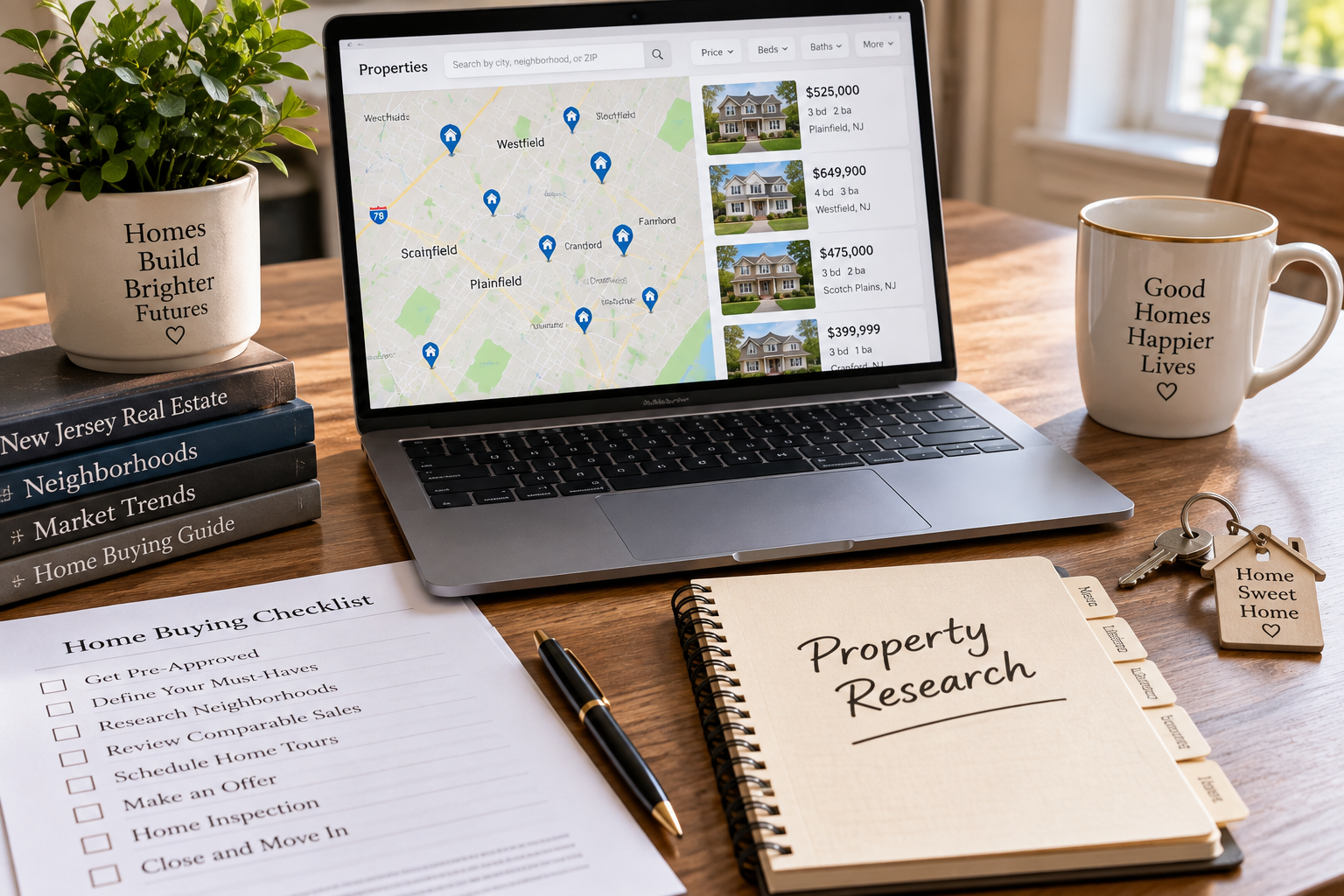
Consider visiting at different times of day. Drive your expected commute. Stop at local shops. Check parking options. Visit a nearby park. Look at traffic patterns and see how long common trips actually take.
Pay attention to objective details that matter to you, such as road access, housing density, noise levels, public transportation, lot sizes, sidewalks, municipal facilities, and proximity to amenities.
The goal is not to determine whether a neighborhood is universally “good” or “bad.” It is to understand whether the location supports the lifestyle and priorities you have identified for yourself.
9. Compare the Home and the Location Together
Sometimes buyers find a house they love in a location that does not meet their practical needs. Other times, they focus so heavily on a particular town that they overlook a property in a nearby community that might work well for them.
Try evaluating both pieces together.
Consider the home's condition, price, taxes, layout, maintenance needs, property features, transportation access, nearby amenities, and your anticipated length of ownership.
This broader view can help you make a thoughtful decision rather than choosing based on one feature alone.
A Simple New Jersey Neighborhood Checklist
Before deciding whether a location works for you, consider researching:
1. Your commute and transportation options
2. Current property taxes and estimated monthly housing costs
3. Housing styles and property types
4. Nearby shops, dining, healthcare, and everyday services
5. Parks and recreation options
6. Municipal facilities and services
7. Objective school information, when relevant to your search
8. Flood indicators and other property-specific considerations
9. Traffic, parking, and road access
10. Recent home sales and current inventory in your price range
What matters most will depend on your own priorities, which is exactly why comparing communities thoughtfully is so important.
Finding the New Jersey Community That Fits Your Goals
There are many reasons buyers are drawn to different parts of New Jersey, from architecture and transportation options to downtown amenities, parks, housing choices, and access to major employment areas.
The right place to call home is personal.
As a lifelong New Jersey resident and real estate professional, I can help you compare homes and communities using clear, objective information while keeping your budget, priorities, and plans at the center of the search.
Whether you're considering Union, Morris, Middlesex, Somerset, or Essex County, we can look at available homes, recent sales, property taxes, transportation, amenities, and other details that matter to your decision.
Ready to Find the Right New Jersey Home for You?
Thinking about buying in New Jersey but not sure which communities fit what you're looking for? Let's talk about your priorities and create a clear plan for your home search.
I'm here to answer your questions, provide local information, and help make each step feel more manageable.
Contact Christine Cederquist to talk about what you're looking for and start reviewing New Jersey luxury homes that fit your goals.
Christine Cederquist
Realty ONE Group
Phone: +1 908-380-3555
Email: CederquistRealty@gmail.com
Ready to talk about what you are looking for? Reach out and let’s create a focused home-search plan.
FAQs
Is it better to buy or rent in New Jersey in 2026?
It depends on your finances, how long you expect to stay in one place, your monthly budget, and how much flexibility you want. Buying may make sense if you are financially prepared and plan to stay for several years. Renting may be a better fit if you expect to move sooner or want fewer ownership responsibilities.
Is renting cheaper than buying in New Jersey?
Not always. Rent may require less money upfront, but buyers should compare rent with the full cost of homeownership, including the mortgage payment, property taxes, homeowners insurance, maintenance, and any HOA fees. The better comparison is between similar properties in the same area.
How much is the average rent in New Jersey in 2026?
Zillow reported an average asking rent of about $2,400 per month in New Jersey as of September 2026. Actual rent can vary considerably depending on the municipality, property type, size, and amenities.
How much money should I have saved before buying a home in New Jersey?
Your savings should account for more than the down payment. Buyers may also need funds for closing expenses, inspections, moving costs, initial home expenses, and an emergency reserve. Speaking with a lender can help you estimate how much cash you may need for your specific price range and loan program.