NJ Housing Inventory Rises 23.6%: What Sellers Should Know

More Homes, Same Asking Prices: What New Jersey's October 2026 Housing Inventory Means for Sellers
More homes are available across New Jersey, but asking prices are holding steady. In October 2026, active home listings increased 23.6% compared with the previous year, while the statewide median listing price remained at $550,000. What does this mean for homeowners planning to sell as 2027 approaches?
For sellers, this is an important market development.
More available properties mean buyers may have additional choices, making accurate pricing, thoughtful preparation, and strong marketing increasingly important.
However, rising inventory doesn't automatically mean home values are declining or that sellers need to lower their asking prices.
As a lifelong New Jersey resident and real estate professional serving Union, Morris, Middlesex, Somerset, and Essex Counties, I believe homeowners deserve a clear understanding of these changes before making important selling decisions.
Let's look at what the latest figures tell us and how homeowners can prepare for the months ahead.

1. What Does the October 2026 New Jersey Housing Inventory Report Show?
New Jersey had 23.6% more active home listings in October 2026 than in October 2025, while the median listing price remained unchanged at $550,000.
According to Realtor.com-based housing data published by the Federal Reserve Bank of St. Louis, the statewide market recorded the following figures:
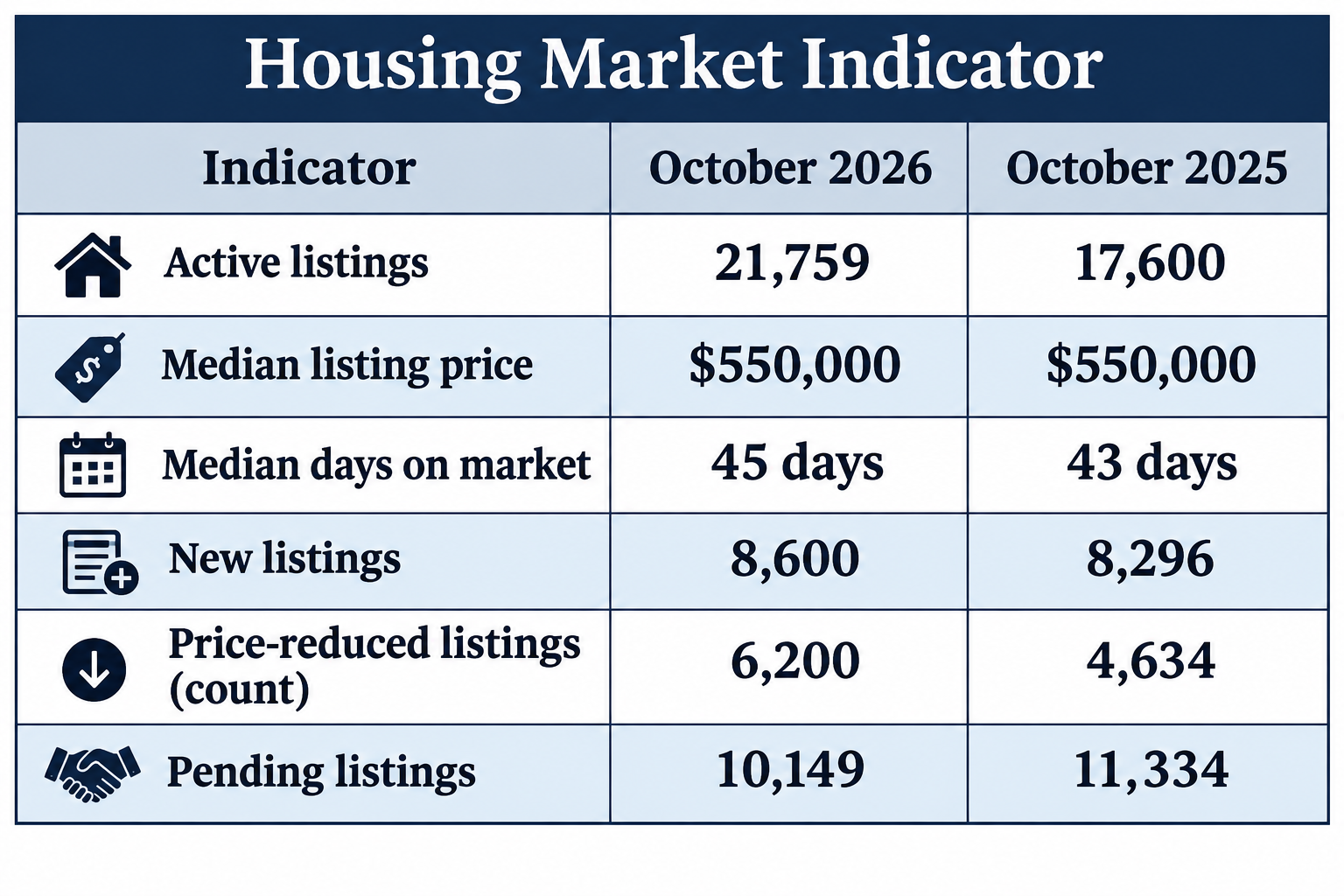
These numbers highlight several important developments.
Available housing increased substantially, while the median asking price remained stable.
Homes also spent slightly longer on the market, and the count of listings with price reductions increased.
Meanwhile, pending listings declined, suggesting fewer properties were moving toward completed sales compared with the previous year.
The takeaway for homeowners is that sellers may be facing greater competition for buyers' attention, even though statewide asking prices have not declined.
📷 Image suggestion: A clean infographic displaying three October 2026 statistics: 21,759 active listings, a 23.6% annual inventory increase, and a $550,000 median listing price. Include a source credit to Realtor.com data via FRED.
2. Why Is More Housing Inventory Important for New Jersey Sellers?
When more homes are available, buyers can compare additional properties before making an offer. That can influence how quickly a home sells and how much flexibility sellers have during negotiations.
During periods of very limited inventory, some buyers may have fewer options within their preferred location and price range.
This can create strong competition for well-maintained properties.
As inventory increases, buyers may become more selective.
For example, if several comparable homes are listed in the same neighborhood, a buyer can evaluate their condition, features, asking prices, and potential ownership costs before deciding which one to pursue.
For homeowners, this means a property needs to compete effectively with other listings.
Important considerations include:
- How the asking price compares with similar properties
- Whether the home is well-maintained
- The quality of listing photographs
- Recent updates and practical features
- The property's layout and outdoor space
- Its proximity to transportation and local amenities
More inventory does not necessarily mean demand has disappeared.
It means sellers may need to be more deliberate about how their properties enter the market.
3. Why Are New Jersey Listing Prices Staying at $550,000?
The unchanged median listing price suggests sellers were generally maintaining similar asking-price expectations in October 2026, despite the increase in available properties.
However, the median listing price is not the same as the median sale price.
The listing price represents what sellers are asking.
The sale price reflects what buyers ultimately agree to pay when transactions close.
A steady median listing price does not establish that every individual home's value has remained unchanged.
Different types of homes may enter the market from one month or year to another, influencing statewide statistics.
For homeowners, this distinction matters.
A property may be worth more or less than the statewide median depending on its location, size, condition, updates, and recent comparable sales.
Your home's asking price should reflect its individual market position, not simply the statewide $550,000 figure.
A personalized market valuation can help determine a more realistic price range.
4. Are More New Jersey Sellers Reducing Their Asking Prices?
The number of listings receiving price reductions increased considerably in October 2026, suggesting some sellers were adjusting their expectations.
The Realtor.com-based FRED data recorded 6,200 price-reduced listings in October 2026, compared with 4,634 in October 2025.
That represents an increase of approximately 33.8% in the count of reduced-price listings.
This does not mean that every price reduction was large or that every seller accepted a lower final sale price.
Some properties may have originally been priced above current market expectations.
Others may have faced additional competition or required repairs that influenced buyer interest.
For sellers, the lesson is not to assume that a price reduction will always be necessary.
Instead, focus on choosing a supported asking price from the beginning.
A thoughtful pricing strategy considers:
- Recent comparable sales
- Competing active listings
- Property condition and improvements
- Neighborhood-level market activity
- The time similar homes are spending on the market
Accurate pricing can help your home attract the right attention without relying on an unnecessarily ambitious starting price.

5. Does More Inventory Mean New Jersey Is Becoming a Buyer's Market?
Not automatically. Rising inventory can give buyers more choices, but the overall balance between buyers and sellers depends on local supply, demand, and the pace of sales.
New Jersey is part of a broader regional trend.
According to Realtor.com's October 2026 Housing Report, active housing inventory across the Northeast increased 16.5% year over year.
However, regional inventory remained approximately 40.2% below pre-pandemic levels.
The report also found that 16.8% of active Northeast listings had experienced a price reduction.
These figures suggest that although housing availability is improving, supply remains limited compared with earlier market conditions.
For New Jersey homeowners, the most useful question isn't whether the entire state has become a buyer's market.
It's whether buyers have more options within the property's specific town, neighborhood, and price range.
Some homes may continue attracting multiple offers, while others may require additional marketing time or pricing adjustments.
6. Are All New Jersey Counties Experiencing the Same Inventory Changes?
No. Inventory growth and housing prices vary considerably across New Jersey, making local market information especially important for sellers.
The Realtor.com-based October 2026 data published by FRED shows differences across several counties.

These figures illustrate why homeowners should look beyond statewide averages.
Even within Union County, market conditions may differ between Plainfield, Westfield, Cranford, and Scotch Plains.
A property in one neighborhood may have several competing listings, while another may face limited direct competition.
Home size, condition, architectural style, and price range can also influence buyer interest.
As a New Jersey real estate professional, I believe understanding these local differences is an important part of helping homeowners make informed pricing decisions.
7. How Can New Jersey Sellers Stand Out When Buyers Have More Choices?
A home that is thoughtfully priced, well-maintained, and professionally marketed can still attract meaningful buyer interest when inventory rises.
The first impression often begins online.
Buyers may review photographs, floor plans, descriptions, and property details before scheduling a showing.
That makes presentation important.
Here are several ways sellers can help their properties compete:
Start with a current home valuation
Review recently sold comparable properties and the homes currently competing for buyers.
Focus on necessary maintenance
Take care of visible repairs and address concerns that could affect buyer confidence.
Prepare each room thoughtfully
Bright, clean spaces and well-arranged furnishings can help buyers understand the home's layout.
Highlight improvements accurately
Updated kitchens, refreshed bathrooms, newer systems, and outdoor features may influence buyer interest.
Invest in professional photography
Quality images should accurately represent the home's condition, room sizes, and strongest features.
Develop a clear marketing plan
A property should be marketed according to its location, price range, features, and current competition.
Not every home requires extensive renovations before selling.
Sometimes practical improvements and stronger presentation are the most appropriate investments.

8. Should Homeowners Sell in Late 2026 or Wait Until 2027?
The right time to sell depends on your property's current market position, your preferred timeline, and your financial goals.
Some homeowners may benefit from listing while their properties are ready and current comparable sales support their asking prices.
Others may prefer to use the coming months to address repairs, organize moving arrangements, or prepare for an early-2027 listing.
Waiting does not guarantee higher prices.
Likewise, listing sooner does not guarantee stronger offers.
Before deciding, ask yourself:
- What is my home worth based on recent comparable sales?
- How much competition exists in my neighborhood and price range?
- What improvements might help buyers appreciate my property?
- What selling timeline makes sense for my goals?
These questions provide a practical starting point.
9. What Could New Jersey's Increasing Housing Inventory Mean for 2027?
If housing inventory continues rising into 2027, some sellers may face more competition and buyers may have additional negotiating flexibility. However, future market conditions remain uncertain.
Several factors will influence the market:
- Mortgage rates and buyer affordability
- The number of homes entering the market
- Local employment and economic conditions
- Changes in buyer demand
- Housing construction and redevelopment activity
- The condition and pricing of competing listings
The October 2026 numbers show that additional housing choices are becoming available.
But that doesn't mean New Jersey homeowners should feel discouraged about selling.
It means preparation and accurate pricing deserve additional attention.
For homeowners considering selling in 2027, understanding your property's current value is one of the best ways to begin planning.
Thinking About Selling Your New Jersey Home in 2027? Let's Start With the Right Price.
If you've been watching more homes come onto the market and wondering what it could mean for your property's value, I'd be happy to help you take a closer look.
As a lifelong New Jersey resident and Realty ONE Group real estate professional serving Union, Morris, Middlesex, Somerset, and Essex Counties, I understand that selling a home is an important financial and personal decision.
My approach begins with listening to your goals, reviewing current comparable sales, and helping you understand how your property compares with today's competition.
From preparing your home for showings to choosing a thoughtful asking price and reviewing offers, my focus is on clear communication, practical guidance, and a selling plan built around your needs.
Whether you're thinking about listing soon or planning a move in 2027, you deserve honest information and steady support.
Curious what your New Jersey home could sell for in today's changing market? Contact me for a personalized home value review, and let's discuss a strategy that works for you.
Christine Cederquist
Realty ONE Group
Phone: +1 908-380-3555
Email: CederquistRealty@gmail.com
I'm here to help you move forward with confidence and clarity.
FAQs
How much did New Jersey housing inventory increase in October 2026?
Active listings increased approximately 23.6% compared with October 2025, rising from 17,600 to 21,759 according to Realtor.com-based FRED data.
What was New Jersey's median listing price in October 2026?
The statewide median listing price was $550,000, unchanged from October 2025. This is the median asking price, not the median price of completed home sales.
What was New Jersey's median listing price in October 2026?
The statewide median listing price was $550,000, unchanged from October 2025. This is the median asking price, not the median price of completed home sales.
Does increasing inventory mean New Jersey home prices will fall?
Not necessarily. Additional inventory can create more competition among sellers, but prices also depend on demand, mortgage rates, property condition, and local market conditions.