New Jersey Housing Market Warning Signs in Late 2026

New Jersey Housing Market Warning Signs: Are Buyers Finally Pulling Back in Late 2026?
Are New Jersey homebuyers starting to pull back as 2026 comes to an end?
Recent housing data suggests that buyers are becoming more cautious. Rising mortgage rates, increasing inventory, and fewer signed contracts are changing market conditions across the country, including signs of slower activity in New Jersey.
For homeowners considering selling in Union, Morris, Middlesex, Somerset, or Essex County, these changes deserve attention.
But does slowing buyer activity mean New Jersey home prices are about to fall? Not necessarily.
While certain indicators point to reduced buyer demand, the housing market remains highly local. Understanding the difference between a market slowdown and a significant price decline can help homeowners make better decisions about when and how to sell.
1. Are New Jersey Homebuyers Really Pulling Back in Late 2026?
Yes, recent data shows signs that buyer activity is slowing, although conditions vary by location and property type.
One of the clearest warning signs comes from the national housing market.
According to the National Association of REALTORS® September 2026 Pending Home Sales Report, released October 20, 2026:
- Pending home sales declined 7.3% from August to September 2026.
- Contract activity fell 11.3% compared with September 2025.
- All four major U.S. regions experienced declines.
Pending home sales track properties that have gone under contract but have not yet closed. Because these transactions often lead to completed sales in subsequent months, they offer an early indication of changing buyer activity.
For New Jersey sellers, this national slowdown is worth watching.
However, national figures do not mean every New Jersey community is experiencing the same conditions.
Properties that are appropriately priced, well-maintained, and presented effectively may still attract serious buyers.
The important difference is that homeowners may need to pay closer attention to their property's competition and the expectations of today's buyers.
2. Rising Mortgage Rates Are Making Buyers More Cautious
Mortgage rates remain one of the biggest challenges facing homebuyers in late 2026.
According to Freddie Mac's Primary Mortgage Market Survey, the average 30-year fixed mortgage rate reached 7.40% on October 15, 2026, compared with 6.27% a year earlier.
That difference can significantly affect monthly mortgage payments and purchasing power.
For example, consider a buyer financing a $400,000 mortgage over 30 years:
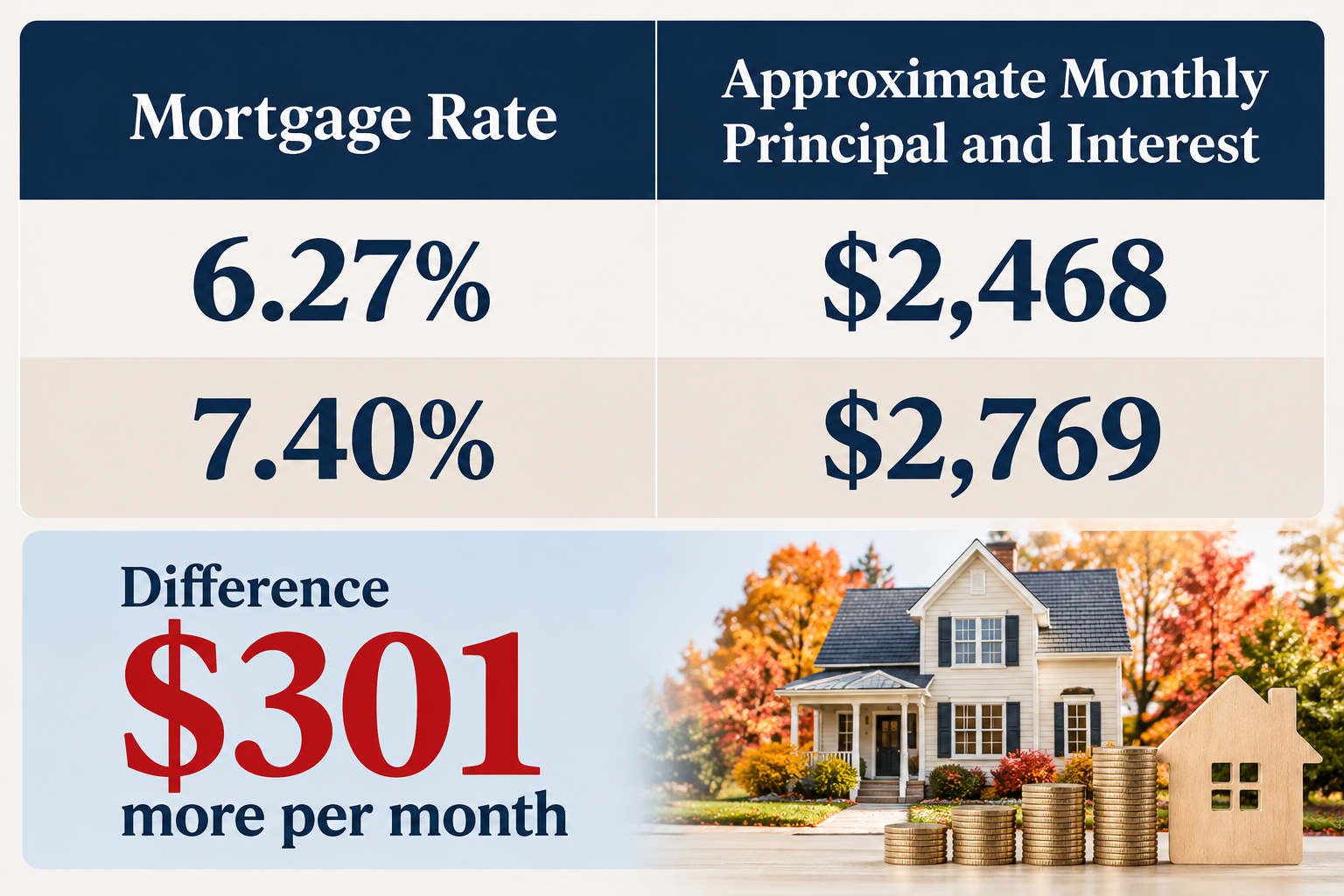
Illustrative calculations only. Payments exclude property taxes, insurance, and other housing expenses.
For potential buyers, an additional $300 per month may affect whether a property fits their budget.
Some may reduce their target price range, delay purchasing, or become more selective about a home's condition and features.
What does this mean for New Jersey home sellers?
It means that pricing a home based solely on previous market highs may no longer be the strongest approach.
Buyers are looking closely at the overall cost of homeownership, including mortgage payments, property taxes, maintenance, and potential improvements.
A seller who understands these concerns can make better decisions about pricing and presentation.
3. New Jersey Housing Inventory Is Increasing
Another important warning sign is the growing number of homes available for sale.
According to Realtor.com housing inventory data published through the Federal Reserve Bank of St. Louis, New Jersey recorded:
- 17,902 active listings in September 2025.
- 20,375 active listings in August 2026.
- 21,036 active listings in September 2026.
That represents approximately 17.5% more active listings than September 2025.
More inventory can be welcome news for buyers because it provides additional choices.
For sellers, however, it can mean more competition.
When several homes with similar prices and features are available in the same area, buyers may take additional time to compare their options.
A property that needs extensive repairs or is priced above comparable listings may struggle to attract attention.
Why home presentation matters
Imagine two similar properties listed in the same New Jersey town.
One has updated photographs, clean landscaping, thoughtfully arranged rooms, and an asking price supported by recent comparable sales.
The other has dated listing photos, several unfinished repairs, and a price that does not reflect competing properties.
In a market where buyers have more choices, the first property may be better positioned to generate interest.
That is why preparation matters, especially when buyer activity is slowing.
4. Are Homes Taking Longer to Sell in New Jersey?
Yes, statewide listing data indicates that homes are spending slightly more time on the market compared with last year.
According to Realtor.com's New Jersey median days on market data, the statewide median reached 45 days in September 2026, compared with 43 days in September 2025.
That increase is relatively modest, but it is another indicator worth monitoring.
A home spending more time on the market does not automatically mean something is wrong with the property.
Several factors can influence selling time, including:
- The asking price compared with similar homes.
- The property's condition and updates.
- The number of competing listings.
- Seasonal changes in buyer activity.
- Mortgage rates and financing requirements.
For homeowners considering selling, the key is understanding how their property compares with current listings in their specific community.
A statewide average cannot tell the full story of what is happening in Westfield, Cranford, Summit, Morristown, Edison, Bridgewater, or Montclair.
Local market conditions should always guide important selling decisions.
5. Are More Sellers Reducing Their Asking Prices?
Across the United States, price reductions are becoming more common as homeowners respond to changing buyer expectations.
According to Realtor.com's September 2026 Housing Trends Report, 20.8% of active listings nationwide had a price reduction during September.
That was the highest September share since 2018.
The same report found that national active inventory increased 5.5% year over year.
These figures suggest that some sellers are adjusting their expectations to attract buyers.
However, the national percentage should not be treated as New Jersey's price-reduction rate.
Does a price reduction mean the housing market is declining?
Not necessarily.
A price adjustment can reflect several situations.
A home may have entered the market at an asking price above what buyers were prepared to pay. Other properties may have recently become available at more competitive prices.
In some cases, sellers simply decide to adjust their pricing to meet a specific timeline.
For homeowners, the lesson is to establish a thoughtful pricing strategy before listing.
Starting with an appropriate asking price can help attract the right level of interest while reducing the possibility of prolonged market time and repeated price adjustments.
6. Is the New Jersey Housing Market Becoming a Buyer's Market?
New Jersey is showing some signs of a market that offers buyers more opportunities, but that does not mean every town has shifted into a buyer's market.
A buyer's market generally develops when there are more properties available relative to buyer demand, often giving purchasers greater negotiating power.
A seller's market occurs when available housing is limited compared with buyer demand.
The current situation is more complicated.
Inventory has increased, but housing availability and competition still differ across communities.
For homeowners in Union, Morris, Middlesex, Somerset, and Essex Counties, local conditions matter far more than a single statewide label.
For example, commuting convenience, property condition, architectural features, nearby amenities, and competing inventory can all influence demand.
Before deciding whether to sell, homeowners should review recent comparable sales, asking prices, time on market, and the number of properties currently available in their town.

7. Should New Jersey Homeowners Be Worried About Falling Home Prices?
A slowdown in buyer activity does not automatically mean that home prices will decline significantly.
Housing prices respond to the relationship between supply and demand, along with financing conditions and local property characteristics.
Even when fewer buyers are purchasing homes, limited inventory in certain towns can continue supporting property values.
What sellers should watch is whether several market indicators begin moving in the same direction.
For example, increasing inventory, longer selling times, fewer pending sales, and a growing number of price reductions could suggest that buyers are gaining negotiating power.
The more important question is not simply whether prices are rising or falling statewide.
It is what buyers are currently paying for homes similar to yours.
An accurate assessment of your property should consider recent sales, current listings, physical condition, location, and improvements.
This provides a more realistic starting point than relying solely on broad market headlines.
8. What Should New Jersey Home Sellers Do Before the End of 2026?
If you are thinking about selling in late 2026 or early 2027, preparation can help you approach the market with more confidence.
Here are five steps worth taking.
1. Review your home's current market value.
Look at recent comparable sales and competing properties. Your home's value may differ from broader county or statewide averages.
2. Address important maintenance concerns.
Buyers may be more cautious about taking on unexpected expenses. Completing necessary repairs and addressing visible maintenance items can help make your home more appealing.
3. Focus on thoughtful presentation.
Clean spaces, natural light, fresh paint where appropriate, and professional photography can help buyers appreciate your property's features.
4. Establish a realistic timeline.
Consider how quickly you would like to sell, your next housing plans, and whether your property requires preparation before listing.
5. Develop a pricing and marketing plan.
A well-supported asking price and a clear marketing approach can help your property compete effectively, even when buyer demand is changing.
The New Jersey REALTORS® Home Selling Resource Center also provides guidance for homeowners preparing to enter the market.
The goal is not to rush into selling or to complete unnecessary improvements.
It is to understand your options and prepare in a way that supports your financial and personal goals.

9. Should You Sell Now or Wait Until 2027?
The right decision depends on your situation.
Waiting until 2027 could give you more time to prepare your home, complete improvements, or coordinate your next move.
However, future mortgage rates, inventory, and buyer demand remain uncertain.
There is no guarantee that waiting will result in a higher selling price or a faster sale.
Likewise, selling before the end of 2026 may be a reasonable option for homeowners who are ready to move and whose properties are well-positioned in their local markets.
Instead of trying to predict the perfect month to sell, it may be more helpful to ask:
- What is my home worth in the current market?
- How much competition exists in my town?
- What improvements are worth making before listing?
- How does my desired timeline affect my selling strategy?
- What would my estimated proceeds look like after selling expenses?
Thinking About Selling Your New Jersey Home? Let's Create a Plan That Works for You.
The New Jersey housing market is showing signs of change, but that doesn't mean homeowners need to feel discouraged.
What matters most is understanding how current conditions affect your property and your selling goals.
As a lifelong New Jersey resident and real estate professional with Realty ONE Group, I understand how important it is to have clear information, honest guidance, and someone who listens to your concerns.
My approach focuses on strategic pricing, thoughtful home preparation, strong marketing, and consistent communication.
Whether you're ready to sell before the end of 2026 or considering a move in 2027, I'm here to help you understand your options and move forward with confidence.
Wondering what your home could sell for in today's changing market?
Let's connect for a personalized home value review and discuss the steps that could help position your property for a successful sale.
Christine Cederquist
Realty ONE Group
Phone: +1 908-380-3555
Email: CederquistRealty@gmail.com
Market information current as of October 21, 2026. National statistics are identified separately from New Jersey-specific data. Housing market conditions may vary by county, municipality, and property type.
FAQs
Are homebuyers pulling back in New Jersey?
A statewide price decline is not guaranteed. Mortgage rates, inventory, local demand, and economic conditions will influence future pricing. Homeowners should evaluate recent sales in their specific communities.
Why are some New Jersey homes taking longer to sell?
Higher borrowing costs, more competing listings, seasonal patterns, property condition, and asking prices can all influence selling time.
Is late 2026 still a good time to sell a home in New Jersey?
It can be, depending on your goals and local market conditions. A well-prepared home with an appropriate asking price can still attract serious buyers.
How can I prepare my New Jersey home for a changing market?
Start with a local home value assessment, address important repairs, improve presentation, review competing listings, and develop a selling strategy based on your timeline and goals.