New Jersey Housing Market Fall 2026: Jobs, Prices and Affordability

New Jersey Housing Market Fall 2026: Jobs, Prices and Affordability
New Jersey homeowners are heading into fall 2026 with a housing market that requires a closer look. Home prices remain higher than a year ago, more properties are coming onto the market, mortgage rates remain near 7%, and the state’s labor market has softened.
For homeowners considering selling, the important question is not simply whether the market is “good” or “bad.” It is how these conditions are affecting buyers, inventory, pricing, and ultimately the strategy behind your own sale.
Here is what the latest numbers tell us.
What Is Happening With Jobs in New Jersey?
New Jersey’s labor market is showing signs of softness as fall begins.
According to the New Jersey Department of Labor and Workforce Development, the state had approximately 4.36 million nonfarm jobs in August 2026. Payroll employment declined by 1,700 jobs from July, while the unemployment rate edged down from 4.4% to 4.3%.
Looking at the year-over-year picture, New Jersey had 9,900 fewer nonfarm jobs than a year earlier.
The story varies considerably by industry. Leisure and hospitality added 3,400 jobs from July to August, while construction added 1,000. Professional and business services lost 3,500 jobs during the month.
Private education and health services stood out over the longer period, adding 22,900 jobs compared with August 2025.
For the housing market, employment matters because job stability and income affect a buyer’s confidence and ability to take on a mortgage. It is one piece of the affordability picture rather than a housing-market indicator by itself.
Are New Jersey Home Prices Finally Coming Down?
Statewide data does not show a broad decline in home prices yet.
According to Redfin, the median New Jersey home sale price reached $587,553 in August 2026, up 2.2% compared with August 2025.
There are also signs of continued buyer activity:
7,421 homes sold during August, up 3.8% year over year.
Homes spent a median 43 days on the market, five fewer days than a year earlier.
48.3% of homes sold above their listing price.
The statewide sale-to-list ratio was approximately 101.3%.
Those numbers are statewide averages, and individual markets can behave very differently. Conditions in Union, Morris, Middlesex, Somerset, and Essex counties can vary considerably by town, property type, price range, condition, and available inventory.
That is why homeowners should be careful about applying a statewide headline directly to the value of their own property.
There Is Some Good News for Buyers: More Homes Are Available
One of the more interesting changes this fall is inventory.
Redfin reported approximately 32,750 homes for sale across New Jersey in August, an increase of 8.8% from a year earlier. New listings also increased 5.2%.
More inventory can give buyers additional choices.
For sellers, however, additional listings also mean presentation and pricing deserve careful attention. Buyers who have more homes to compare may become more selective about condition, updates, layout, location, and asking price.
That does not mean every seller needs to complete an expensive renovation.
Sometimes smaller improvements such as fresh paint, repairs, lighting changes, landscaping, decluttering, and professional presentation can make a meaningful difference in how buyers respond to a home.

Why Does Housing Still Feel Expensive?
Home prices are only one part of affordability. Financing costs matter too.
Freddie Mac reported that the average 30-year fixed mortgage rate was 7.03% as of September 24, 2026, while the average 15-year fixed rate was 6.42%.
Earlier in September, the 30-year average was 6.71%. By September 24, it had moved above 7%.
That difference matters because mortgage rates directly affect monthly principal and interest payments.
Freddie Mac provides a useful illustration. At a 7% interest rate, principal and interest on a $300,000, 30-year mortgage would be approximately $1,996 per month. At 7.5%, that rises to about $2,098, before property taxes, homeowners insurance, association fees, or other housing expenses.
For buyers already balancing New Jersey home prices with taxes and everyday expenses, financing costs can affect the price range they are comfortable pursuing.

Is New Jersey Building Enough Housing?
Housing supply remains a major part of New Jersey’s affordability discussion.
State officials have identified housing shortages as one contributor to rising home prices and rents and have announced several programs aimed at increasing housing production.
In June 2026, the state announced additional steps through the New Jersey Housing Opportunities for Municipal Equity and Success initiative, commonly called NJ HOMES. The program provides selected municipalities with planning and technical assistance aimed at increasing housing production.
The New Jersey Housing and Mortgage Finance Agency has also been raising money through state tax credit auctions to support affordable and workforce housing development. In July, NJHMFA announced that it had sold $40 million in state tax credits and planned another auction for the fall.
These efforts may add housing over time, but development does not happen overnight. For homeowners and buyers making decisions this fall, existing local inventory remains an important factor.

What Does All of This Mean for New Jersey Home Sellers?
The fall 2026 market presents sellers with competing signals.
Prices remain above last year’s statewide level, and nearly half of August sales closed above asking price. At the same time, buyers are dealing with mortgage rates around 7%, inventory has increased, and employment data is softer than it was a year ago.
That makes preparation especially important.
A seller may benefit from focusing on four areas:
1. Price according to the local market. Statewide averages provide context, but recent comparable sales in your town and price range matter much more.
2. Prepare the home before photography and showings. Buyers comparing more listings may pay closer attention to condition and presentation.
3. Make improvements selectively. Before spending heavily on renovations, determine which updates are most likely to matter to buyers in your specific market.
4. Pay attention to the first few weeks on market. Buyer response, showing activity, feedback, and competing listings can provide useful information about whether your initial strategy is working.

Should You Wait for Mortgage Rates to Fall Before Selling?
There is no single answer that works for every homeowner.
Mortgage rates can influence demand, but trying to perfectly time interest rates can create another problem: nobody knows with certainty where rates will be several months from now.
Your decision may depend more on your home’s current value, equity, financial goals, timeline, next housing plans, and conditions in your particular New Jersey town.
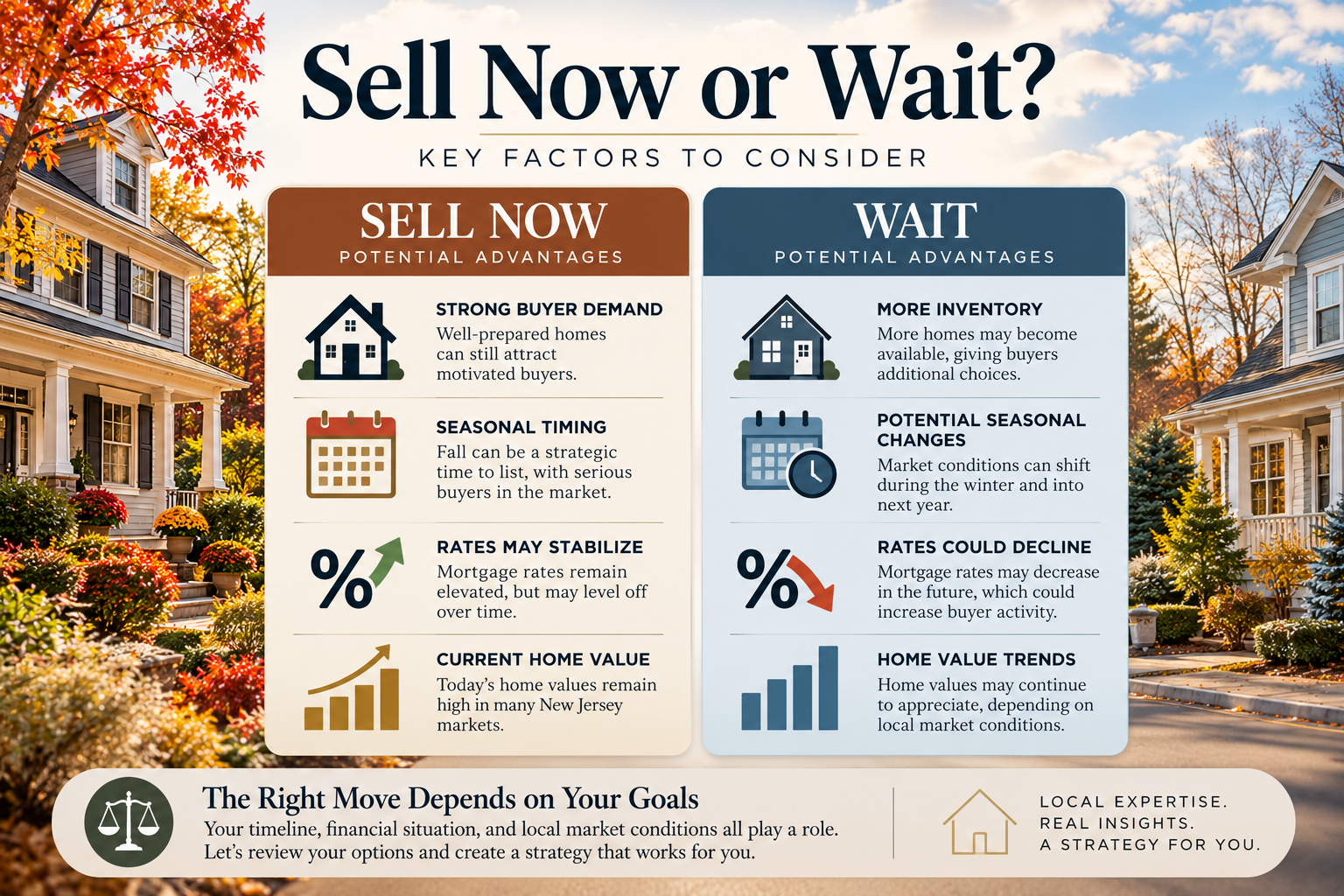
For some homeowners, waiting may make sense. For others, current prices and local buyer demand may provide a reason to consider selling now.
The better starting point is understanding the numbers that apply specifically to your property.
What Should New Jersey Homeowners Watch This Fall?
Three numbers deserve attention during the remainder of fall 2026: local inventory, mortgage rates, and recent sale prices.
Employment data is worth watching as well because a sustained change in hiring and unemployment can eventually affect consumer confidence and housing demand.
Most importantly, avoid making a real estate decision from a single headline.
New Jersey is made up of highly localized housing markets. What is happening in one town, price range, or property category may look very different just a few miles away.
That is where local data becomes much more useful than statewide averages.
Thinking About Selling Your New Jersey Home?
If selling has been on your mind, you do not need to make the decision based on headlines alone.
I can help you look at what homes similar to yours are actually selling for, how much competition is currently on the market, what buyers are responding to, and which preparations may be worth considering before you list.
As a lifelong New Jersey resident and real estate professional serving Union, Morris, Middlesex, Somerset, and Essex counties, my goal is to give homeowners clear information and a thoughtful selling plan without adding unnecessary pressure.
Curious what your home could sell for in today’s market? Let’s talk about your property, your timeline, and the numbers that matter to your decision.
Christine Cederquist
Realty ONE Group
Phone: +1 908-380-3555
Email: CederquistRealty@gmail.com
FAQs
Are New Jersey home prices falling in fall 2026?
Statewide data does not show prices falling year over year as of August. Redfin reported a median sale price of $587,553, approximately 2.2% higher than August 2025. Individual cities and property categories can show different trends.
Is New Jersey getting more homes for sale?
Yes. Redfin reported 32,750 homes for sale statewide in August 2026, an 8.8% increase from a year earlier. New listings were also up 5.2%.
What is New Jersey’s unemployment rate?
New Jersey’s unemployment rate was 4.3% in August 2026, according to the New Jersey Department of Labor and Workforce Development.
What are mortgage rates this fall?
Freddie Mac reported an average 30-year fixed mortgage rate of 7.03% as of September 24, 2026. Rates change frequently, and the rate available to an individual borrower depends on several factors.