How Much Home Can You Afford in New Jersey in 2026?

How Much Home Can You Afford in New Jersey in 2026?
The answer depends on much more than your annual salary. Your mortgage rate, existing debts, down payment, property taxes, homeowners insurance, and monthly lifestyle expenses all affect the price range that makes sense for you.
And here is the number that may surprise you: New Jersey's median sale price reached $602,831 in July 2026, according to Redfin.
That does not mean you need to spend $600,000 to buy a home in New Jersey. It means buyers need to approach affordability strategically. Instead of asking only, "What is the maximum mortgage I can qualify for?" a better question is, "What monthly housing payment can I comfortably afford while still enjoying the rest of my life?"
This guide will help you answer that question by looking at 2026 home prices, mortgage rates, property taxes, down payments, buyer assistance programs, and the difference between getting approved and being financially comfortable.
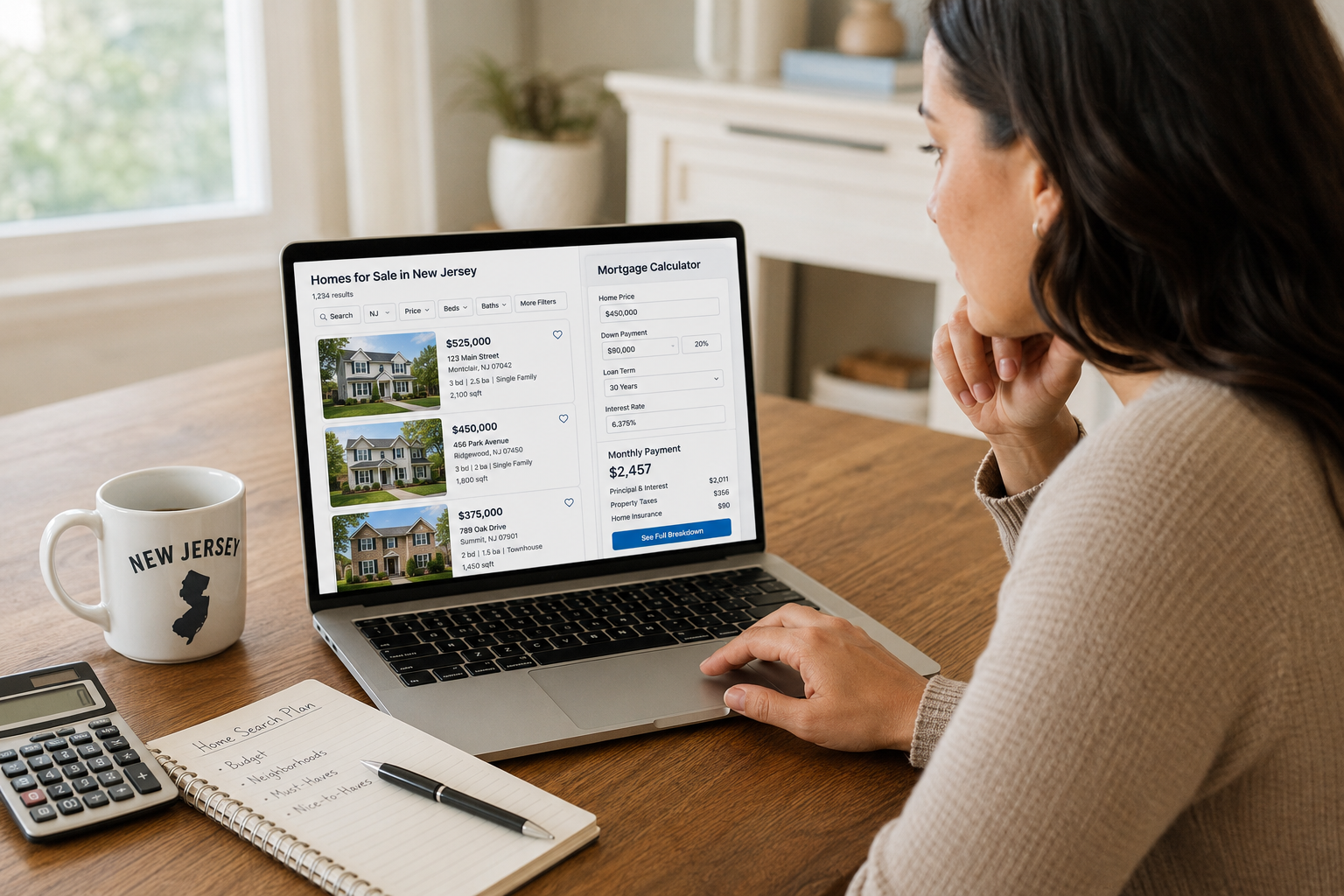
The amount of home you can afford in New Jersey depends on your total monthly housing cost, not simply the home's purchase price.
Your monthly housing budget may include:
* Mortgage principal
* Mortgage interest
* Property taxes
* Homeowners insurance
* Mortgage insurance, if applicable
* Homeowners association fees, if applicable
Your lender will also consider debts such as auto loans, student loans, credit cards, and other recurring obligations.
NJ REALTORS® offers an affordability calculator that asks buyers to account for gross annual income, monthly debts, down payment, interest rate, insurance, and property taxes when estimating an affordable home price.
The important takeaway is simple: your home price is only one piece of the affordability equation.
A $500,000 home in one New Jersey municipality could carry a noticeably different monthly cost from a similarly priced home somewhere else because taxes, insurance, and association fees can vary.
What Do Homes Cost in New Jersey in 2026?
New Jersey home prices remain high in 2026, but statewide figures should be used as context rather than as your personal home-buying budget.
According to Zillow, the typical New Jersey home value was approximately $584,072 as of July 31, 2026, up 3.6% over the previous year.
Redfin measures the market differently and reported a statewide median sale price of $602,831 in July 2026, representing a 7.6% year-over-year increase.
Why are those numbers different? Real estate data companies use different methodologies and metrics. More importantly, neither statewide number tells you exactly what homes cost in the specific New Jersey communities you are considering.
Prices can differ substantially by county, town, property type, school district, commute, lot size, condition, and other factors.
That is why affordability should become a local search, not simply a statewide calculation.
How Does Your Income Determine How Much House You Can Afford in New Jersey?
Your income establishes the foundation of your budget, but lenders also compare that income with your monthly debt obligations.
This relationship is commonly referred to as your debt-to-income ratio, or DTI. In simple terms, DTI compares your recurring monthly debts with your gross monthly income.
For example, two buyers earning $120,000 per year might qualify for very different mortgage amounts.
Buyer A may have no car payment, minimal credit card debt, and a large down payment.
Buyer B may earn exactly the same salary but have a $700 monthly car payment, student loans, credit card balances, and a smaller down payment.
Their incomes are identical, but their buying power is not.
This is why online calculators are useful for creating a starting estimate, but they cannot replace an individual mortgage review. NJ REALTORS® also advises buyers to consider all financial obligations when determining how much they can afford.

How Much Do Mortgage Rates Affect Your Buying Power in New Jersey?
Mortgage rates can significantly change your monthly payment even when the home price stays exactly the same.
Freddie Mac reported that the national average rate for a 30-year fixed mortgage was 6.66% as of August 27, 2026.
If you purchased a $500,000 home with 20% down, you would finance approximately $400,000. At a 6.66% 30-year fixed interest rate, the principal and interest payment would be approximately $2,571 per month.
That estimate does not include property taxes, homeowners insurance, HOA fees, or other potential housing expenses.
This is where buyers sometimes get caught off guard. You might comfortably handle the mortgage principal and interest, but once taxes and insurance are included, the total payment may move beyond your preferred budget.
Mortgage rates also vary by borrower and lender. Credit profile, loan type, points, down payment, and other factors can affect the rate you are offered.
Why Do New Jersey Property Taxes Matter When Calculating Affordability?
Property taxes should be part of your affordability calculation from the beginning because they contribute directly to your monthly housing expense.
This is especially important when comparing homes across New Jersey.
Imagine finding two homes priced around $500,000. At first glance, they seem equally affordable. But if one property carries significantly higher annual taxes, its total monthly housing cost could be noticeably higher.
That is why I encourage buyers to look beyond the listing price.
For every serious property you consider, examine:
* Current property taxes
* Estimated mortgage principal and interest
* Homeowners insurance
* HOA or condominium fees
* Mortgage insurance, when applicable
* Expected maintenance and utility costs
A home is affordable when the complete monthly cost works for your finances, not simply when the asking price falls below your mortgage approval.
How Much Down Payment Do You Need to Buy a Home in New Jersey?
You do not automatically need a 20% down payment to buy a home in New Jersey.
NJHMFA explains that a down payment is typically 3% or more, depending on the mortgage program, while putting less than 20% down may result in mortgage insurance requirements.
Different mortgage programs have different requirements.
For example, NJHMFA's June 2026 Homeward Bound fact sheet notes that FHA financing requires 3.5% down, while eligible VA and USDA borrowers may be able to purchase with no down payment.
So why would someone choose to put more money down?
A larger down payment can:
* Reduce the amount you need to borrow
* Lower your monthly principal and interest payment
* Potentially reduce or eliminate certain mortgage insurance costs
* Give you more equity from the beginning
But draining your entire savings account just to produce a larger down payment is not automatically the best strategy either.
You may still need money for inspections, moving expenses, furnishings, repairs, emergencies, and the normal surprises that come with homeownership.
Can First-Time Homebuyers Get Down Payment Assistance in New Jersey in 2026?
Yes. Qualified New Jersey buyers may have access to state programs that help with down payment and closing costs.
The New Jersey Housing and Mortgage Finance Agency currently offers a statewide Down Payment Assistance Program providing qualified first-time buyers with up to $15,000, depending on the county where the home is purchased. The assistance is structured as an interest-free, five-year forgivable second loan with no monthly payment and must be paired with an eligible NJHMFA first mortgage.
NJHMFA also offers additional assistance for eligible first-generation homebuyers. Combined assistance can reach $17,000 to $22,000 for qualified borrowers.
NJHMFA generally defines a first-time homebuyer as someone who has not owned a home during the previous three years, although program-specific requirements and exceptions can apply.
Income limits, purchase-price limits, property requirements, loan requirements, and funding availability can apply, so speak with a participating lender before assuming you qualify.
Could assistance make the difference between waiting another year and becoming a homeowner sooner? For some New Jersey buyers, it is absolutely worth investigating.
Should You Spend the Maximum Amount Your Lender Approves?
Not necessarily. Your mortgage approval tells you what a lender may be willing to finance, but your comfortable budget is a personal financial decision.
This may be the most important point in the entire article.
If you are approved for a $600,000 purchase, you do not have to shop at $600,000.
You may decide that $525,000 gives you more flexibility for vacations, childcare, retirement contributions, home repairs, restaurants, hobbies, or simply having breathing room in your monthly budget.
Your maximum mortgage approval is a financing ceiling, not a spending goal.
Ask yourself:
* What monthly payment feels comfortable?
* How much do I want left after housing costs?
* Could I manage an unexpected repair?
* Am I still saving after buying the home?
* Will this payment work if another household expense increases?
* Do I want to be house-rich but cash-poor?
Most buyers focus intensely on whether they can buy a particular home. A better strategy is to also ask whether buying that home will allow them to live the way they want after closing.
Why Should You Get Preapproved Before Shopping for Homes in New Jersey?
A mortgage preapproval gives you a clearer understanding of your financing position before you become emotionally attached to a property.
Your lender can review your income, credit, assets, debts, down payment, and loan options to help establish a practical purchasing range.
Once you have that information, your home search becomes much more focused.
Instead of browsing everything from $400,000 to $700,000, for example, you may discover that your comfortable target range is closer to $475,000 to $550,000.
That clarity saves time.
It can also help identify financing questions early, before you are trying to write an offer on a home you love.
Remember, though, a preapproval still does not tell the whole story. You should review the taxes and other expenses associated with each property before deciding whether the payment works for you.

How Can a New Jersey Real Estate Agent Help You Stay Within Budget?
The right real estate agent can help turn your mortgage budget into a practical home-search strategy.
Once I understand the payment range you are comfortable with, the goal is not simply to show you every property below a certain list price.
The better approach is to look at the whole picture.
That can mean helping you compare communities, property taxes, HOA fees, home condition, commute considerations, and the types of properties available at different price points.
Technology can also make the search more efficient by helping organize listings and identify properties that closely match your needs. But technology is only a tool. Your final buying decisions should combine accurate financing information, property-specific details, professional guidance, and your personal priorities.
The goal is not to convince you to buy the most expensive home possible.
The goal is to help you find the right home at a payment that supports both homeownership and the life you want to live.
How Much Home Can You Afford in New Jersey? Start With the Payment, Not the Price
Buying a home in New Jersey in 2026 requires more than choosing a listing price that looks affordable.
Start with your income and debts. Understand your mortgage rate. Estimate property taxes and insurance. Explore your down payment options and available buyer-assistance programs. Most importantly, decide what comfortable homeownership looks like for your household.
A lender can help determine what you qualify to borrow. Your real estate agent can then help you translate that financing into a focused search for homes and communities that match your needs.
Ready to find out what your New Jersey home-buying budget really looks like?
Before you start touring homes, let's narrow down the price range, locations, and monthly payment that fit your goals. Contact me today to start your New Jersey home search with a clear plan and confidently focus on homes that make sense for you.
Ready to talk about your home-buying goals? Reach out and let’s put together a clear plan for your next move.
Christine Cederquist
Realty ONE Group
Phone: +1 908-380-3555
Email: CederquistRealty@gmail.com
FAQs
How much income do I need to buy a $500,000 house in New Jersey?
There is no single salary that guarantees you can afford a $500,000 New Jersey home. Your lender will consider your income along with existing debt, down payment, mortgage rate, property taxes, insurance, and other qualification factors. Two households earning the same salary can therefore qualify for very different loan amounts. A lender can calculate the range based on your specific financial profile.
How much house can I afford in New Jersey with a $100,000 salary?
It depends heavily on your debt, down payment, interest rate, property taxes, and other housing expenses. A buyer earning $100,000 with very little debt may have more purchasing power than someone earning the same amount with large auto, student loan, or credit card payments. Instead of relying on salary alone, calculate the complete monthly payment and discuss your qualifications with a mortgage professional.
Do I need 20% down to buy a house in New Jersey?
No. A 20% down payment is not universally required. NJHMFA notes that down payments may start around 3% depending on the mortgage program, while FHA financing generally requires 3.5%, and eligible VA or USDA borrowers may have zero-down options. Putting less than 20% down can result in mortgage insurance depending on the loan.
What first-time homebuyer assistance is available in New Jersey in 2026?
NJHMFA offers qualified first-time buyers down payment and closing-cost assistance of up to $15,000 through its statewide DPA program. Eligible first-generation buyers may qualify for additional assistance, bringing combined assistance to as much as $17,000 to $22,000. Program limits, lender requirements, and other eligibility conditions apply.